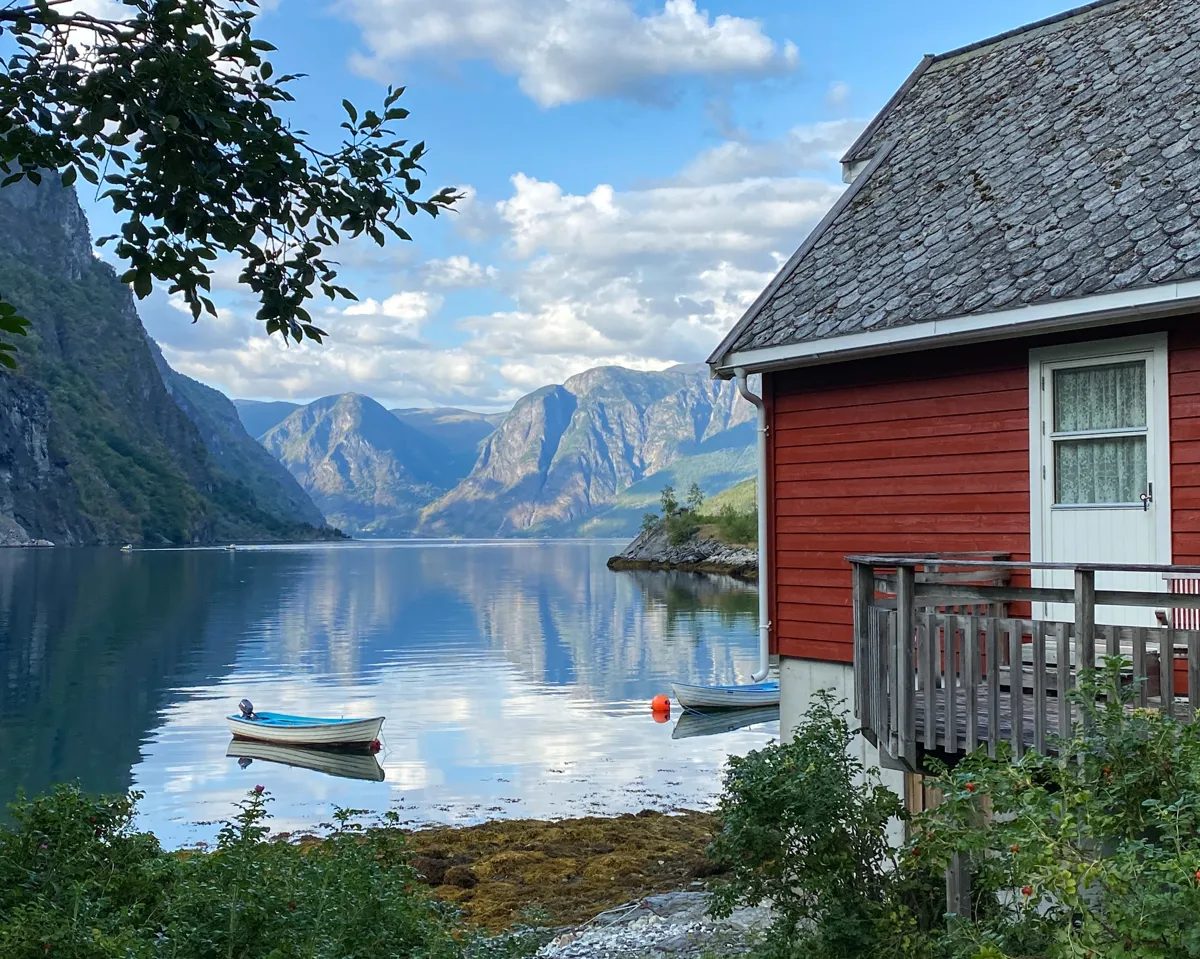
Aurland, Norway
The Aurlandsfjord is a narrow, steep-sided arm of the Sognefjord in Vestland, western Norway, and it packs the full drama of a deep Norwegian fjord into a stretch that is genuinely easy to reach. It runs about 29 kilometers inland, rarely more than 2 kilometers wide, with dark water that plunges close to 960 meters deep and mountains rising as much as 1,800 meters almost straight from the shoreline. Waterfalls streak the cliffs after rain and snowmelt, small farms cling to the few shelves of flat land, and near the mouth the even narrower Nærøyfjord splits off to the west; both arms belong to the Nærøyfjord section of the West Norwegian Fjords UNESCO World Heritage Site. The innermost point is the village of Flåm, with tiny Undredal and its famous goat cheese partway along the shore. The single best vantage is Stegastein, a wooden platform that juts 30 meters out from the mountainside 650 meters above the water, laying out almost the whole fjord at once.
Most people take it in from the water: the Flåm to Gudvangen cruise threads the Aurlandsfjord and then the tighter Nærøyfjord in about two hours, while kayaks and small RIB safaris (some stopping at Undredal for cheese) get you right under the cliffs. Flåm is also the terminus of the Flåmsbana railway, which climbs more than 800 meters in an hour, and that combination pulls cruise ships and thousands of day-trippers into a village of only about 400 residents. That crowding is the main thing to plan around: in July and August Flåm is packed and rooms book out months ahead, so aim for late spring or September, when the weather still holds and the crowds thin. If you drive up to Stegastein, the road from Aurland is only 8 kilometers but steep and single-lane with seven hairpin bends, and the pass beyond it stays closed through winter. Fjord weather turns quickly whatever the forecast says, so pack real rain gear and layers, and don't count on renting a car locally.